


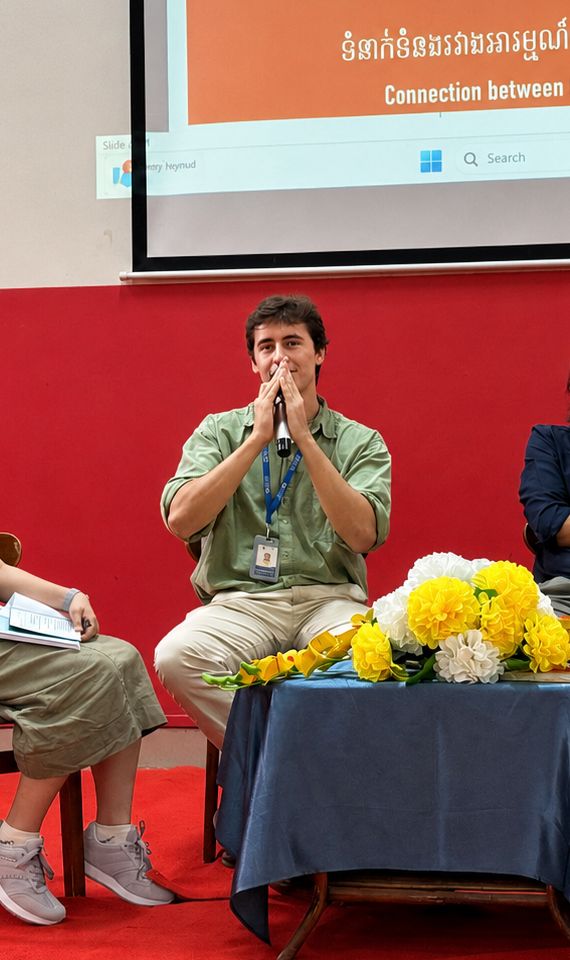

A journey shaped by one conviction: children stay where they feel safe.
Fernando Restoy · The Ripple Effect
My name is Fernando, and my professional path began in 2014, when I first volunteered at Pour un Sourire d'Enfant — PSE — in Cambodia, supporting children affected by extreme poverty, violence, neglect, drug addiction, and sexual exploitation.
This experience changed the direction of my life.
During a visit to a dump site, I saw children walking through kilometers of waste, insects, and needles, searching for plastic they could sell. They were focused on their work until they saw us approaching. For a brief moment, they stopped and began to play. Then their parents came out of nearby shelters and shouted at them to return to work.
I remember leaving that place with a deep sadness I had never felt before. It was the first time I witnessed children being pulled away from their natural state of play, safety, and innocence, and forced into survival. That moment became the beginning of my commitment to child protection.
Beginning


At the time, my motivation was clear, but I did not yet know how to help in a structured or effective way. I continued returning to Cambodia every summer, working closely with children, families, and educators. Over time, I began to understand that the challenges children faced were not only material. Poverty was part of the story, but so were intergenerational trauma, domestic violence, emotional neglect, family instability, and the absence of safe relationships at home and at school.
I came to see that children do not leave school only because they lack resources. Many disengage because they do not feel safe, seen, supported, or emotionally connected. This realization shaped one of my deepest convictions: dropout prevention is inseparable from child protection.
▶ Watch video about PSEIn 2016, while pursuing a Master's degree, I read Emotional Intelligence by Dr. Daniel Goleman. The book gave language and structure to what I had been witnessing in Cambodia. It helped me understand the importance of recognizing and regulating emotions, cultivating empathy, and building relationships that allow both children and adults to feel safe, connected, and supported.
After completing my Master's degree, I interned at the United Nations Headquarters in New York, where I initiated and coordinated the first UN Conference on Emotional Intelligence. Dr. Goleman and his team participated in the conference and later invited me to join their Emotional Intelligence Coaching Certification training program and work with Goleman EI, an organization that trains coaches, leaders, and teams in emotional intelligence.
I went on to become a Certified Emotional Intelligence Coach under Dr. Goleman's teachings, and worked as a consultant for Goleman EI, supporting and delivering training for professionals, organizations, and business leaders. During this period, I also contributed to international conversations on emotional intelligence through webinars, podcasts, a speaking engagement at the World Economic Forum in New York, and had the privilege of being the co author of the chapter "Emotional Intelligence and the Sustainable Development Goals" in the Encyclopedia of the UN Sustainable Development Goals.
Intelligence


Cambodia
Throughout these years, I continued returning to Cambodia and deepening my professional training in neuroscience, education, mindfulness, nonviolent communication, trauma-informed practice, and child protection. These disciplines strengthened my belief that effective safeguarding must combine clear systems with emotional intelligence, relational safety, and the everyday skills that help children and adults thrive.
In 2022, I relocated to Cambodia to work full-time at PSE, transforming a long-standing commitment into a professional mission: to build child protection and student retention systems that are preventive, emotionally grounded, and responsive to the realities of vulnerable children.
At PSE, I designed and led a Child Protection and Student Retention Programme to strengthen safeguarding systems and ensure sustained access to education for students at risk of harm, disengagement, or dropout.
I built the programme from the ground up, establishing systems for early identification, referral, case management, risk assessment, follow-up, and family coordination.
We also recruited, trained, and supervised a multidisciplinary team of child protection officers and educators, strengthening institutional safeguarding procedures across a school of 1,000 students. Over three years, our team supported more than 450 children facing protection and educational risks, including cases related to bullying, family conflict, domestic violence, neglect, emotional abuse, and sexual abuse. Through structured screening, risk triage, coordinated case management, and close collaboration with families, teachers, and school leadership, the programme achieved more than 75% student retention after three months and contributed to reducing overall dropout from 14% to 10%.
I also delivered child protection and care capacity-building training to more than 90 staff members, strengthening early identification, trauma-informed responses, and safe learning environments.
▶ Watch video about programmeRetention


Intervention
To reduce dropout below 10%, I led the design of an early-intervention model for students showing initial signs of disengagement before concerns escalated. The model combined structured check-ins, rapid case classification, emotional support, family follow-up, and relationship-based interventions. It achieved 98.94% retention in pilot classes, compared with 95.29% in non-pilot classes, and improved attendance among older students. The early intervention model was then adopted school-wide and implemented in the support system.
Finally, I led the implementation of Social and Emotional Learning curricula across 17 classes, equipping 420 students with protective skills such as self-awareness, emotional regulation, resilience, empathy, relationship-building, and responsible decision-making.
Read moreI believe in the integration of emotional and relational safety into child protection and dropout prevention systems. I like to apply emotional intelligence, emotion coaching, and Nonviolent Communication not as abstract concepts, but as practical safeguarding tools. They help educators build safe relationships, support students in naming and regulating emotions, identify emotional abuse and relational breakdown before they escalate, and embed trauma-informed practices into daily school life.
Through The Ripple Effect, my work is rooted in one conviction: children stay where they feel safe.
By strengthening the relationships, systems, and emotional environments around children, we can make schools not only places of learning, but places of protection, healing, and possibility. This is how we reduce dropout. This is how we prevent harm. And this is how we help break cycles of trauma and poverty, one child, one relationship, and one safe environment at a time.
Approach


Why "The Ripple Effect"
I named this work The Ripple Effect because I believe every interaction with a child has the power to travel beyond that moment. When children feel understood, validated, respected, and safe, they begin to relate to themselves and others in the same way. These experiences ripple outward across friendships, classrooms, families, and communities, and forward across generations.
Over time, emotionally safe and educated children can become adults who carry empathy, responsibility, and care into the world around them. In this way, child protection is not only about responding to harm; it is about creating the conditions for healing, belonging, and transformation. One safe relationship can influence one child. One child can influence many others. And those ripples can help break cycles of trauma and poverty, shaping stronger communities and a more compassionate future.

PSE beneficiaries (2017) — Photo: Lana Lenfant